
Best tactical shooter games can feel wildly different depending on what you mean by “realistic”, because one player wants true-to-life recoil and comms discipline, while another just wants believable gunfights and high-stakes teamwork without memorizing a 40-keybind loadout.
That gap matters because tactical shooters punish mismatched expectations, buy the wrong game and you bounce off in two nights, buy the right one and you suddenly have a “one more round” problem for months.
Below, I’ll help you sort realism into a few practical buckets, then map popular games to those buckets, with quick ways to self-check what you’ll actually enjoy, plus setup tips so your first sessions feel playable rather than punishing.
What “realistic” usually means in tactical shooters
Realism gets thrown around as a vibe, but in tactical shooters it usually lands in a few specific places, and you can like one without liking the others.
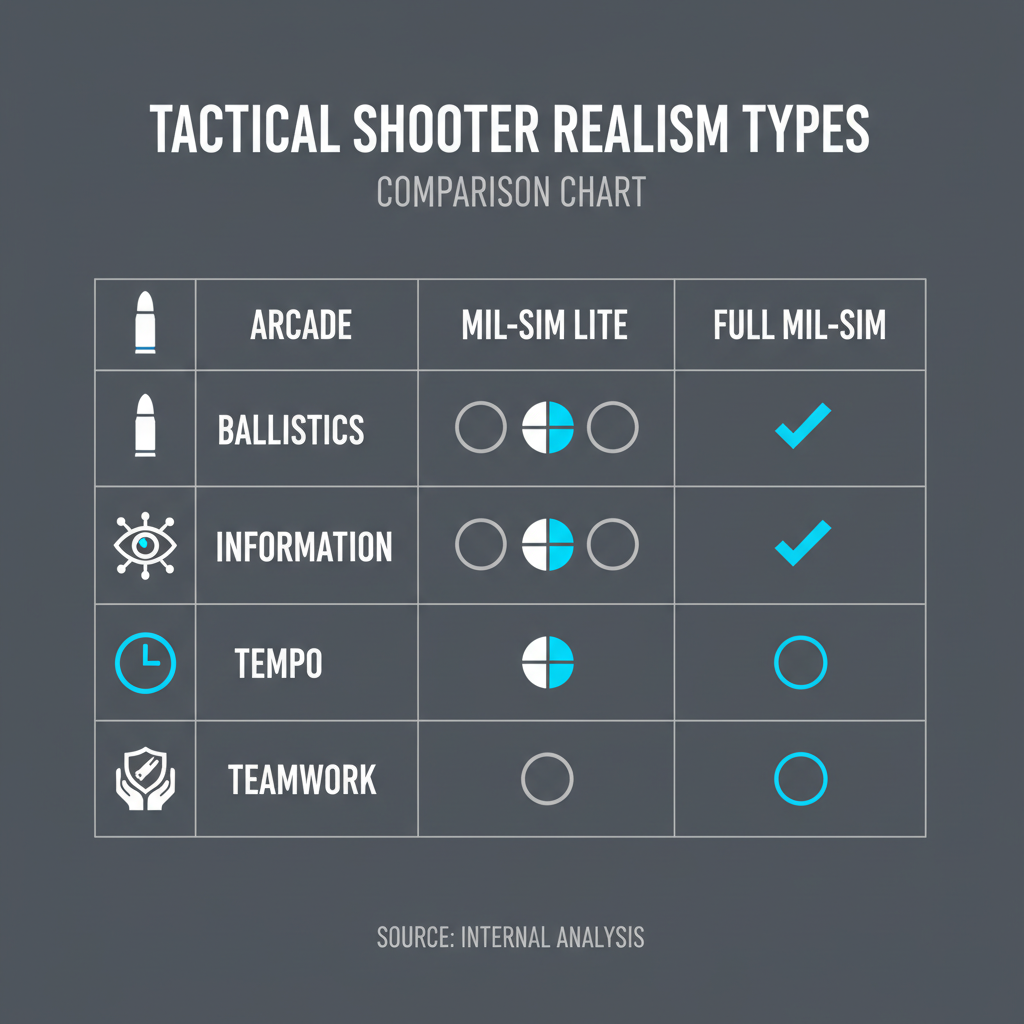
- Ballistics realism: bullet drop, penetration, armor interaction, recoil behavior.
- Information realism: limited HUD, no enemy outlines, sound matters, fog-of-war.
- Tempo realism: slow clearing, consequences for rushing, short time-to-kill.
- Team realism: roles, comms, coordination, punishments for lone-wolf play.
- Scenario realism: believable missions, rules of engagement, hostage or bomb logic.
According to ESRB, game ratings focus on content and age suitability rather than “realism,” so it’s on you to match the specific realism type you want with the game’s actual design.
Quick comparison table: popular picks by realism style
If you want a fast shortlist, this table is the easiest starting point. “Best” here means best fit for that realism flavor, not a single winner for everyone.
| Game | Realism focus | Typical pacing | Team reliance | Platform notes |
|---|---|---|---|---|
| Escape from Tarkov | Ballistics + survival stakes | Slow-to-burst | Medium | PC; demanding learning curve |
| Squad | Communication + combined arms | Deliberate | High | PC; best with mic |
| Ready or Not | Close-quarters procedure | Methodical | High | PC; co-op shines |
| Arma 3 | Simulation sandbox | Variable | Medium-High | PC; mods and communities matter |
| Insurgency: Sandstorm | Lethality + audio cues | Medium | Medium | PC/console; accessible but sharp |
| Rainbow Six Siege | Competitive tactics (not sim) | Fast-structured | High | PC/console; steep PvP meta |
Picking the right game: a self-check that actually works
Most people pick based on clips, then discover the day-to-day loop feels different. Answer these honestly and you’ll get closer to your “right” version of best tactical shooter games.
1) How much frustration budget do you have?
- Low: you want to learn by playing, not by reading a wiki for three hours.
- Medium: you’re fine failing early if the feedback is clear.
- High: you enjoy brutal onboarding and long-term mastery.
2) What’s your tolerance for losing progress?
- If losing gear makes you stressed, extraction and loot-loss games may feel like work.
- If stakes motivate you, those same games feel “alive” in a way others don’t.
3) Do you actually want to talk to strangers?
- No mic, solo vibe: look for modes that still function with pings and short callouts.
- Mic, teamwork: you’ll get more value from games built around squads and roles.
Best tactical shooter games by “realistic” priority (and who they fit)
Instead of ranking everything in one messy list, here are solid picks grouped by the realism lever they pull hardest. This is where you should spend your decision energy.
For high-stakes realism: Escape from Tarkov
If “realistic” means stress, uncertainty, and consequences, Tarkov sits in its own lane. Gunfights often end quickly, and the threat of losing your kit changes how you move, when you shoot, and what risks feel rational.
- You’ll like it if: you enjoy planning routes, learning maps, and managing limited resources.
- You may bounce off if: you want clear fairness signals and quick, repeatable matches.
For comms and coordinated infantry: Squad
Squad rewards players who treat information like currency, you pass it, you protect it, you act on it. A good squad leader can make an average shooter feel effective, which is a very specific kind of fun.
- You’ll like it if: you want teamwork that goes beyond “group up and shoot.”
- You may bounce off if: you hate downtime or relying on strangers to do basics.
For realistic procedure in tight spaces: Ready or Not
Ready or Not leans into door discipline, angles, and de-escalation choices depending on scenario and server expectations. It’s not a perfect mirror of real-world law enforcement, but the structure pushes you to slow down and think.
- You’ll like it if: you want co-op where planning matters more than twitch aim.
- You may bounce off if: you’re allergic to careful room clearing and repetition.
For sandbox simulation: Arma 3
Arma tends to be “as serious as your group makes it.” The base game can feel clunky, but communities and mods can turn it into anything from casual ops to near-milsim evenings with real SOP-style structure.
- You’ll like it if: you enjoy big maps, logistics, and emergent stories.
- You may bounce off if: you want tight, polished gunplay out of the box.
For lethal, readable firefights without full sim: Insurgency: Sandstorm
Sandstorm often hits the sweet spot for players who want danger and immersion, but still want to jump in after work and feel productive. Audio, angles, and restraint matter, yet the loop stays match-based.
- You’ll like it if: you want intensity without a survival economy.
- You may bounce off if: you need long-form objectives and drawn-out strategy.
For tactical competition (realistic-ish, but not sim): Rainbow Six Siege
Siege is “tactical” through information denial, gadgets, and coordinated execution, not through ballistics simulation. It can feel realistic in decision-making, even when the toolset is intentionally gamey.
- You’ll like it if: you enjoy mastering maps, operators, and team protocols.
- You may bounce off if: you want grounded loadouts and consistent realism tone.
Practical setup tips so the first 3 hours don’t feel awful
This part gets ignored, then people blame the game. A few small choices can make “realistic” feel fair instead of punishing.
Audio and comms
- Use headphones if you can, sound cues drive most tactical decisions.
- Set push-to-talk early, open mic chaos kills teamwork.
- Use short callouts: direction + distance + intent, not a full novel.
Controls and visibility
- Lower mouse sensitivity until tracking feels steady, tactical shooters rarely reward flick-only habits.
- Turn off extra overlays if the game relies on visual scanning and subtle movement.
- Bind a few essentials near your movement keys, then stop adding binds “just in case.”
Learning approach
- Pick one map and one mode, repeat until your brain stops doing panic math.
- Watch short guides only after you’ve played enough to know what you’re confused about.
- If co-op exists, use it as a bridge before PvP, your confidence will climb faster.
Common mistakes when shopping for “realistic” tactical shooters
A lot of disappointment comes from buying for the fantasy, not the routine. These are the traps I see most often.
- Confusing realism with difficulty: some games are hard because systems are opaque, not because combat is believable.
- Ignoring community culture: the same game can feel welcoming in one server and miserable in another.
- Assuming solo play will feel tactical: many titles become “spawn, sprint, die” if you refuse teamwork tools.
- Chasing graphics as a proxy: pretty lighting doesn’t guarantee readable fights or good netcode.
- Buying on hype, not loop: ask what you do minute-to-minute, not what highlights look like.
According to PEGI, consumer advice often emphasizes understanding content descriptors and online gameplay factors, and that’s relevant here too: online interactions and community behavior can shape your experience as much as mechanics.
When to get extra help (or at least change your plan)
If you keep bouncing off “realistic” shooters, it doesn’t always mean you’re bad, sometimes you’re missing the support structure the game expects.
- You feel lost every match: join a beginner-friendly Discord or a server that labels itself as new-player friendly.
- You can’t hear anything useful: ask someone to review your audio settings, or look up the game’s recommended dynamic range.
- You get tilted fast: consider co-op, PvE modes, or shorter-match tactical shooters while you build fundamentals.
- Hardware discomfort: if prolonged headphone use causes pain or headaches, it may help to adjust fit or volume, and if symptoms persist, consider asking a healthcare professional.
Conclusion: how to choose fast without regretting it
The best tactical shooter games for “realistic” play usually match your preferred realism type: high-stakes survival, disciplined comms, close-quarters procedure, or competitive tactical execution. Once you name that preference, the right pick gets obvious and the wrong ones stop tempting you.
If you only do two things, do these: choose a game whose core loop you’d enjoy even on a losing night, and set up audio and comms before you judge the gunplay. That combination saves you time and, honestly, money.
Key takeaways
- “Realistic” isn’t one feature, it’s a bundle, decide which part you care about most.
- Match your frustration budget to the game’s onboarding and punishment level.
- Team-based tactical shooters feel better with a mic and a beginner-friendly group.
- Small setup fixes often change the entire first impression.
FAQ
What are the best tactical shooter games that feel realistic but aren’t overwhelming?
Many players find match-based titles with high lethality and clear objectives easier to stick with, because you can learn fundamentals without managing a full survival economy. Insurgency: Sandstorm is a common entry point for that reason, though your mileage varies by mode and server.
Is Rainbow Six Siege considered a realistic tactical shooter?
It’s tactical in decision-making and team structure, but realism is not its core promise. If you want grounded simulation, Siege may feel too “ability-driven,” yet if you want tight coordination and map knowledge, it can still scratch the tactical itch.
Which realistic tactical shooters are best for co-op PvE?
Look for games designed around clearing spaces and managing threats with teammates, not just dueling other players. Ready or Not often gets recommended for co-op because it rewards planning, patience, and role discipline.
Do I need a microphone for tactical shooters?
You don’t always need one, but you’ll usually get more out of squad-based games if you can at least listen, and ideally speak. If you truly dislike voice chat, prioritize titles with strong ping systems or modes that don’t depend on real-time coordination.
What’s the most realistic tactical shooter on PC?
“Most realistic” depends on whether you mean ballistics, procedures, or battlefield coordination. Tarkov, Squad, and Arma 3 each push realism in different directions, so it’s better to pick the one that matches your definition rather than chasing a single crown.
How do I get better fast in tactical shooters without grinding aim trainers?
Work on decisions before mechanics: slow your entries, hold better angles, and learn common sound cues. Recording a few matches and rewatching your deaths can reveal pattern mistakes faster than pure aim practice.
What should I look at before buying a “realistic” tactical shooter on Steam?
Check the core loop, required time per match, and whether the game expects teamwork. Also scan recent patch notes and community hubs for onboarding friction points, because updates and server culture can change how welcoming a game feels.
If you’re trying to pick between a few options and want a more “no-regrets” route, list your must-haves like PvE vs PvP, match length, and whether you’ll use voice chat, then choose the game that aligns with those constraints instead of the one with the coolest clips.